
2026 applications are now closed. Thank you for your interest in our project, and stay tuned for updates!
Concerned about rising nitrogen prices but worried about the risks of reducing nitrogen rates?
Our project is designed to help Ontario corn farmers optimize nitrogen rates through split nitrogen application in their fields, but without the risk of losing profit. Just like a warranty, this project will pay farmers in the case of lost profits (factoring in yields, operating costs, and input cost savings) due to implementing split nitrogen application on enrolled acres. This will minimize the risks associated with implementing this practice.
Participation in this project is free for selected farmers and offers the following supports:
Up to $500 in agronomist services for project support (inclusive of tax), including nutrient management recommendations
Full reimbursement for a required pre-sidedress nitrate test (PSNT), a soil test that will help guide how much nitrogen to apply
A $1,000 honorarium for your time
There are still spaces remaining! If you are interested in participating, we encourage you to review the project’s requirements, frequently asked questions, and apply today! If you have any questions, please contact innovation@farmersforclimatesolutions.ca.
Today’s producers face increasing challenges, from extreme weather to rising input costs. It may be harder than ever to farm today, with tight margins and complex management decisions that can have significant impacts on profitability. Our project is designed to improve farm profitability, boost resilience, and optimize nitrogen use.
Every farm business is unique, and considering whether you integrate a new practice can come with different risks, unique to your operation. Our profit warranty is designed to provide a safety net that supports improved on-farm management, allowing you to try a new practice while protecting your profitability. Our goal is to assess if a profit warranty can be a helpful new tool to optimize nitrogen use.
The Profit warranty to optimize nitrogen rates project is led by Farmers for Climate Solutions, the Smart Prosperity Institute, and the Nature Investment Hub. It is part of a broader project exploring new tools to de-risk on-farm innovation.
Requirements
Participating producers must:
Be growing grain corn in Ontario in 2026.
Select between 1-3 fields to include in the project.
Have existing insurance coverage (e.g., multi-peril protection covering weather issues) for the project field(s).
Per field, perform soil-applied split nitrogen application on at least 20 acres of grain corn, with no greater than 30 lbs N/ac at planting/pre-plant.
Maintain a minimum of 5 acres using business-as-usual practices in a representative area compared to the enrolled area, e.g. same soil type, similar topography, similar previous management practice.
Collect and share data, including accurate yield data (yield monitor, weigh wagon, truck scales, etc.), fertilizer management, and other field management practices.
Follow Good Farm Management Practices, including appropriate weed control and soil fertility management (i.e. maintaining appropriate pH and meeting crop nutrient needs for phosphorus and potassium, etc.).
Work with an agronomist, or be an agronomist, to interpret a PSNT and apply the recommended rate.
Participate in post-harvest project evaluation through a short survey and/or conversation to gather feedback and your insights.
Frequently asked questions
Why split apply nitrogen in corn? ▼
Nitrogen is one of the most easily lost nutrients. Weather and moisture play a large role, factors that are outside of a farmer’s control. But, nitrogen is a significant cost, so eliminating wastage improves profitability and it also reduces loss to the environment in the form of water or air pollution.
Split nitrogen applications can allow a farmer to be more responsive in their nitrogen rates based on the growing season and any losses that may occur between preplant applications and major crop demand. The goal is to ensure the crop has the right amount of nitrogen when it needs it most. When done right, splitting nitrogen applications has the potential to increase farm profit through optimized nitrogen budgets and improved yields, while also benefiting the environment. For an example of recent research completed in Ontario, see this trial summary from Soils at Guelph.
Why a pre-sidedress nitrate test (PSNT)? ▼
Understanding the right amount of nitrogen to put down for a corn crop is challenging, and the most economical rates vary year to year depending on weather conditions. Split applying nitrogen based on pre-sidedress nitrate test (PSNT) analysis allows you to be more nimble in response to the growing season–which can result in lower input costs and higher profits–all while benefiting the environment.
Taking a PSNT in the first or second week of June is the optimal timing to assess the impact of spring rain volumes on the availability of nitrogen already in your soil. Based on Ontario Ministry of Agriculture, Food and Agribusiness (OMAFA) recommendations, Ontario soil labs and agronomists are able to make specific recommendations based on the soil nitrate level, your sample timing, and your yield target.
What is the application process? When would this start? ▼
Once you have submitted your application, we will contact you within two weeks to share more information about the project and ask a few additional questions to ensure this project is a good fit for your farm. If you are selected to participate, we will share detailed project materials and offer support to ensure you have everything you need as soon as possible.
What does being part of the project involve? ▼
Participants are expected to:
- Select between 1-3 fields for the project, each with a business-as-usual area of at least 5 ac, and a new practice area of 20-25 ac where the PSNT will be implemented.
- Plant a minimum 5 acres per field using business-as-usual practices in a representative area compared to the new practice area, e.g. same soil type, similar topography, similar previous management practice
- Work with an agronomist to prepare nutrient management recommendations for the enrolled field(s). The nutrient recommendation should include fertilizer type, application timing, method and rates, and the dates for Pre-Sidedress Nitrate Test (PSNT). A project guide and nutrient management reporting template will be provided to participants.
- Limit any combination of preplant and starter fertilizer to 30 lbs N/ac in the new practice acreage.
- Perform a PSNT with an agronomist at the recommended timing (within the first or second week of June) and apply the second round of nitrogen fertilizer in late June or early July, based on test results and agronomist recommendations.
- Track activities, costs and profitability. Information that will be collected by project administrators include:
- Actual fertilizer blend application rate, placement, timing, and cost
- Cost of split applying the fertilizer (if different than the OMAFA provincial average, e.g. $17/ac in 2025)
- Yield, moisture, and test weight of the the business-as-usual area and the new practice area
- PSNT cost
- Row spacing, corn hybrid, and crop growth stage at PSNT sample time and sidedress time
- The field history for the last two years of manure, compost, cover crop, and other organic nitrogen sources
- Once harvest is complete, submit the business-as-usual and new practice yield results to project administrators.
- Participate in project evaluation to gather feedback and insights, and identify lessons learned.
What is a profit warranty? ▼
A profit warranty protects profit. It provides farmers with a payment if a new practice or product results in a profit loss. The intent of a profit warranty is to offer a buffer for the short-term risk of profit loss during practice adoption, allowing producers to better assess the practice and implement it with more confidence and certainty.
For this project, profitability is determined with a partial budget approach, accounting for key factors for each farm such as corn and fertilizer prices, fertilizer application rates, changes in operating costs from practice adoption, and yields. The goal of this project is to understand the effectiveness of the profit warranty to encourage improved nitrogen management.
How is my potential payment calculated? ▼
Coverage will be based at a maximum corn price of $7.50 per bushel. The maximum available coverage for this program is 10% of business as usual yield, capped at 20 bu/ac. In the event that a participant is unable to conduct a second application of nutrients due to extreme weather, coverage may be raised to 20% of the business as usual yield or 40 bu/ac. Payments over 20% are not guaranteed and will be assessed on a case by case basis. If you are unable to complete your second fertilizer application or your crop insurance policy is triggered for your project field(s), participants are required to contact administrators.
Research in Ontario has demonstrated that split application is generally profitable; for example, a study from the Elora Research Station found it profitable in both wet and dry years (which increased profitability 15 to 20%). However, there is variability in the practice, and in average weather years saw a reduced profit by 9% (related to later application in their trial at V13). Our warranty is intended to cover this expected range in yield variability, and buffer any additional operational costs from adding a second application pass.
Coverage for the project is calculated using the following equations:
Per Acre Coverage = Change in Yield & Management Costs - Fertilizer Savings
Change and Yield and Management Costs = (Yield Reduction/acre x Price of Corn/bu) + Cost of Split Application/acre
Fertilizer Savings = Cost of Fertilizer/kg N x Difference in kg of N/acre
For example, a producer with a 25 acre field might decide that they want to sidedress nitrogen fertilizer to 20 of these acres and use the remaining 5 acres for the business-as-usual area. Business-as-usual areas do not receive the profit warranty, and instead, are used to calculate the difference in management costs and yields between the new practice and business-as-usual areas.
The results of the project are as follows:
- There is a 4 bu/ac reduction in yield between the business-as-usual and new practice areas
- Price of corn is $5.30/bu (ON average for 2025 per OMAFA Field Crop Budgets Publication)
- Split application machinery costs are $16.21/acre (average custom operation costs in ON)
- Cost of fertilizer is $1.87/kg (ON average for 2025)
- Reduction of nitrogen is 5 kg/acre
With these values, the coverage would be calculated as follows:
Change and Yield and Management Costs
(4 bu/acre x $5.30) + $16.21 = $37.41
Fertilizer Savings
$1.87/kg N x 5 kg/acre = $9.35
Per Acre Coverage
$37.41 - $9.35 = $28.06 per acre
How much nitrogen can I apply? ▼
In the area implementing PSNT testing, participants can apply no more than 30 lbs N/ac pre-emergence. The targeted fertilizer amount for the second application will be determined following PSNT (taken in the first two weeks of June), and in consultation with your agronomist.
Is 30 lbs of nitrogen enough starter? Why have that limit? ▼
When planning your nitrogen management program around a split application, 30 lbs N/ac is sufficient as a starter rate. A corn crop takes up very little nitrogen in the first 60 days of growth, and 30 lbs N/ac, plus soil nitrogen supply, will meet the crop’s requirements during this period.
The 30 lbs N/ac limit was set for this project based on OMAFA recommendations for the PSNT test. The PSNT measures available soil nitrate existing in the soil at the time the sample is taken. In Ontario, PSNT rate recommendations from OMAFA have been established based on the 30 lbs N/ac starter limit, and applying higher levels of starter can have an effect on the calibrations of the test, resulting in inaccurate sidedress recommendations.
Will I work with an agronomist? ▼
Yes, participants are asked to work with an agronomist who will provide support in the form of:
- Project field lay out if needed
- Starter nutrient management recommendations
- PSNT and associated recommendations for sidedress nitrogen products and rates
For work done by your agronomist, a subsidy of up to $500, inclusive of tax, will be provided for the agronomist's time (receipt required). If you do not already have your own agronomist, we will do our best to connect you with one.
How much land can I include in the project? ▼
Participants can choose to enroll between 1-3 fields in this project. Each field requires its own business-as-usual area, each with a minimum of 5 acres, and an area managed under the new practice, which must be between 20-25 acres. These 20-25 acres per field are the area that will be supported by the profit warranty in the event of a profit loss. Therefore, a maximum of 75 acres can be covered under the profit warranty if three fields of 25 acres implement the new practice.
Do I have to pay to participate? ▼
No. There are no costs to participate in this project and be eligible to receive compensation payments.
Are costs related to implementing split application reimbursed? ▼
PSNT costs will be reimbursed. Technical support provided by an agronomist will also be reimbursed, up to $500 inclusive of tax. Receipts or invoices are required for both of these eligible costs to be paid out. All other costs related to implementing split application (e.g. machinery, labour) are not directly covered, and are the responsibility of the participant. If costs related to labour and equipment use for a split application are a new practice compared to your business-as-usual management, this will be factored into your budget and covered by the warranty in the case of profitability loss. In recognition of time spent planning and delivering your project and providing feedback to the research team, each participant will receive an honorarium of $1000 after the project is completed.
Do I need existing crop insurance coverage to participate in this project? ▼
The profit warranty does not replace crop insurance. Participants must maintain and carry multi-peril and weather based insurance. If a multi-peril insurance policy is triggered on the enrolled acreage, project coverage will be annulled.
Who is involved? ▼
The project is an initiative of Farmers for Climate Solutions, the Smart Prosperity Institute, and the Nature Investment Hub. These organizations are working together on a project exploring innovative financial tools to de-risk BMP adoption.
How long does this project last? ▼
This project was first delivered as a pilot in the 2025 growing season, and currently, is expanded for the 2026 growing season. Similar opportunities may be offered in the future.
Want to stay up-to-date on this project?
- Sign up for our newsletter to read the results and find out about upcoming opportunities to get involved in this initiative
- Contact innovation@farmersforclimatesolutions.ca to share ideas or ask questions.

This project is supported by Canadian philanthropic organizations, as well as Definity.
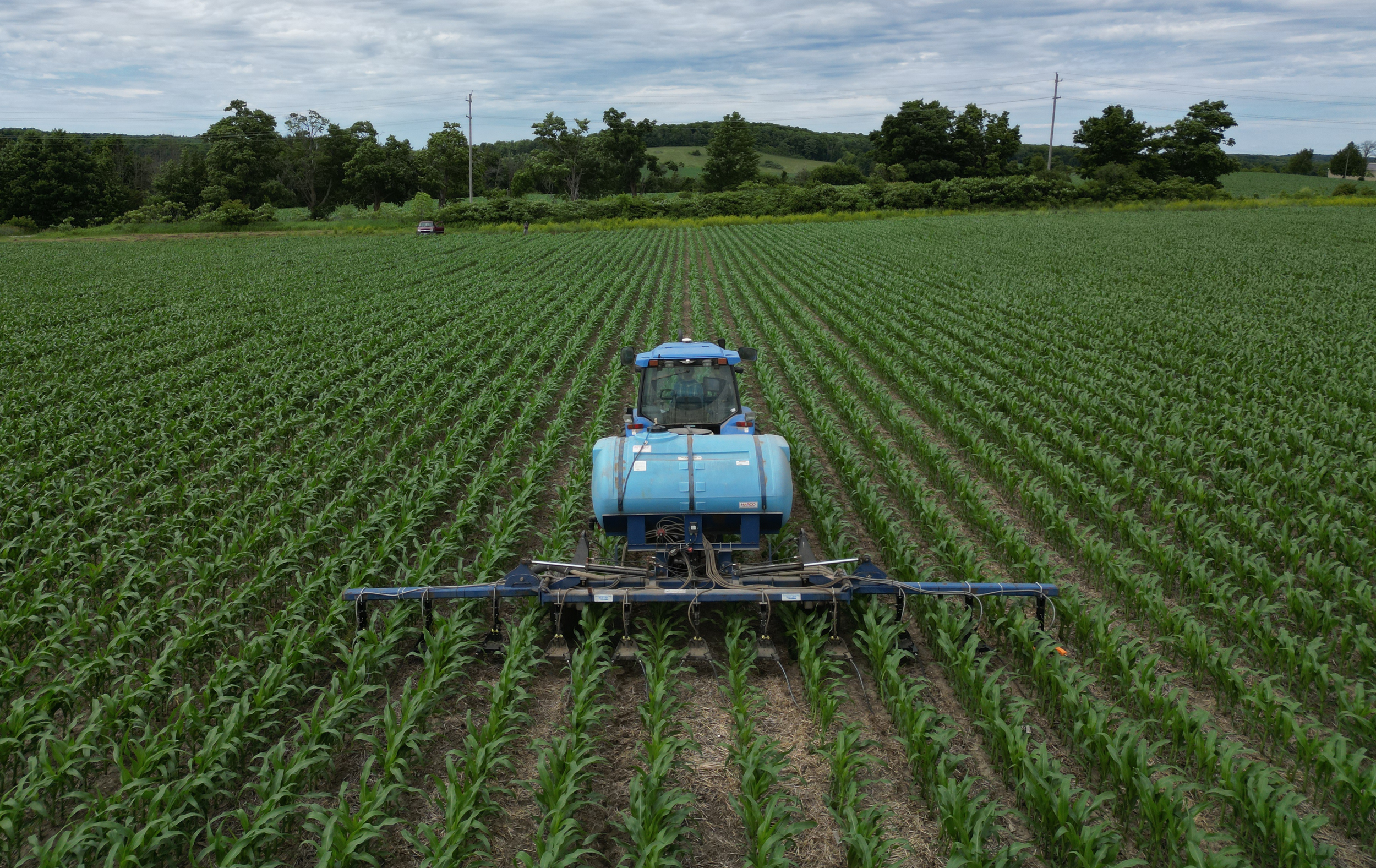
Cover image: Sidedressing corn and seeding cover crop at Woodleigh Farms in Cavan, ON